
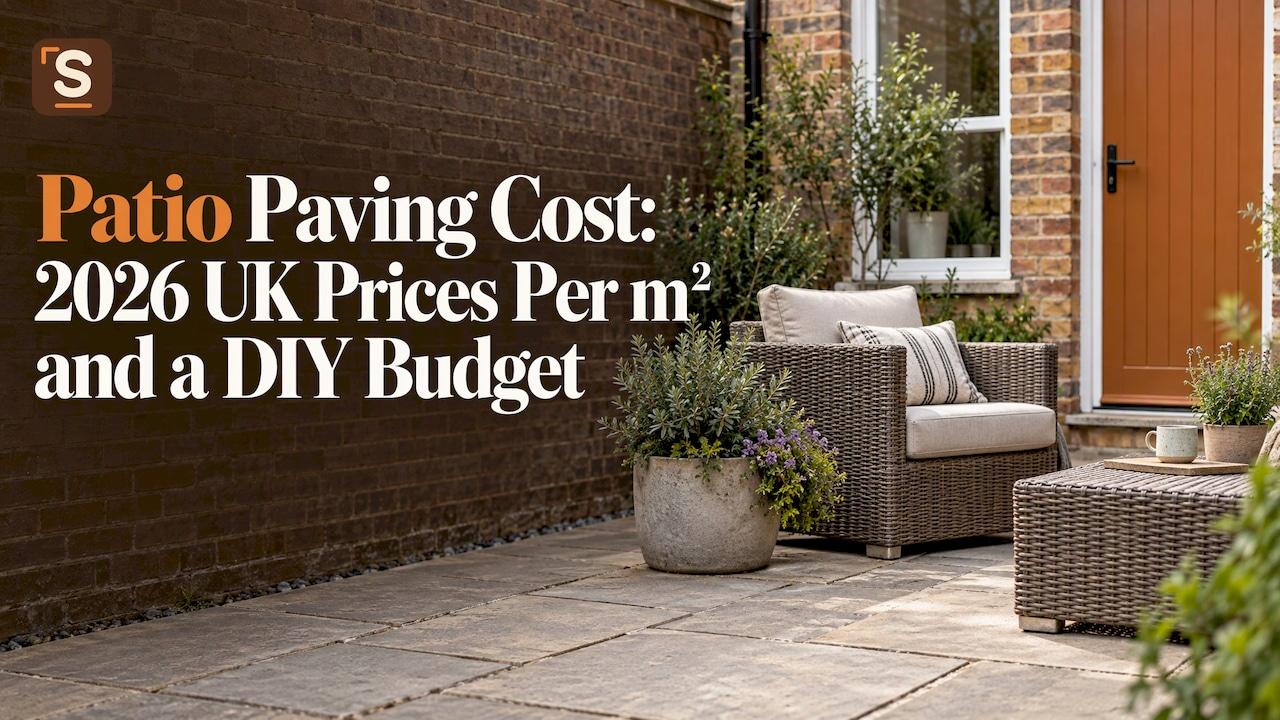
A laid patio in the UK typically costs £70 to £180 per m² when a professional installs it, and a standard 20m² patio lands somewhere between £900 and £4,600 depending on the paving and the groundwork. If you lay it yourself, the paving is only part of the bill: sub-base, sand, cement, jointing and a skip make up the rest, and that is where most DIY budgets go wrong. This guide gives you the 2026 per-m² figures by material, a worked DIY materials budget for 20m², and the extras people forget. If you would rather get a plan built around your own garden, you can describe the job to Scopebase in plain English and get a materials list, cost estimate and steps, with no account needed to try it.
TL;DR
- Professionally laid patios run about £70 to £180 per m², with concrete at the bottom and porcelain or natural stone at the top.
- Delivered paving starts around £20/m² for riven Indian sandstone and £18/m² for porcelain, but slabs are typically only 40 to 50% of the total project cost.
- A DIY 20m² sandstone patio comes to roughly £940 to £1,400 in materials once sub-base, sand, cement, jointing and skip hire are counted (worked example below).
- Groundwork, drainage and access can move the final price by 20 to 40%, so budget for the base before you choose the slab.
- Measure first, add 10% for cuts, and list every layer from soil to jointing before you spend anything.
Table of Contents
- What a patio costs in the UK in 2026
- Patio paving cost by material
- Patio cost by size
- Where the money goes besides the slabs
- What a professional charges for labour
- A worked DIY budget: 20m² Indian sandstone patio
- The costs people forget
- How to estimate your own patio cost in five steps
- Plan it before you buy it
- Our view: price the layers, not the slabs
- FAQ
- Sources
What a patio costs in the UK in 2026
Published guides agree on the shape of the answer, even where the exact numbers differ. One 2026 guide puts a standard 20m² patio at £900 to £2,500 including excavation, foundations and paving. Another says most UK homeowners pay £2,000 to £5,000 depending on material, size and groundwork. A third quotes £2,400 to £4,600 for a fully laid 20m² patio.

The spread is wide because the jobs are not the same. A flat, accessible lawn with a simple rectangle of concrete slabs sits at the bottom. A sloping, awkward plot with natural stone, a drainage channel and a skip sits at the top. These are published 2026 figures, and builders' and suppliers' prices move through the year, so treat them as a guide for planning and check current prices with your merchant before you order.
Most domestic patios are between 10m² and 40m²: about 10m² for compact seating, up to 40m² for a full family entertaining space. Work out your own area first. Multiply length by width for a rectangle, or split an irregular shape into rectangles and add them together.
Patio paving cost by material
The biggest single cost variable is the paving you pick. One 2026 guide notes that labour to lay it is broadly similar whatever the material, so the material choice drives the difference between a cheap patio and an expensive one.
There are two kinds of figure to keep apart. Supply-only prices are what the slabs cost delivered. Installed prices include groundwork, bedding and labour. Mixing the two is the most common reason a budget looks fine on paper and falls apart on site.
| Material | Supply only (delivered, inc. VAT, 2026) | Installed per m² (2026 guides) |
|---|---|---|
| Concrete slabs | Varies by range | £50 to £80 |
| Indian sandstone | £20/m² riven, £25/m² sawn | £80 to £130 |
| Porcelain | £18/m², typical range £18 to £45 | £100 to £180 |
At the extremes, one price guide describes a typical patio as running from about £50/m² for basic concrete slabs to £180/m² or more for porcelain or natural stone.
Concrete slabs
The lowest-cost route. For a 20m² job, medium-range example costs run from £900 to £2,000 installed. Concrete slabs are forgiving to lay and easy to cut, which suits a first patio.
Indian sandstone
The popular natural-look option. Riven (textured) is cheaper than sawn (cut-edged, more uniform) at the supply stage. Sandstone is a sensible middle ground: it looks like stone, and the laying method is the familiar mortar-and-sand bed.
Porcelain
Porcelain slabs can be cheap to buy but costlier to lay. One guide explains that porcelain needs a full mortar bed plus a priming slurry coat and resin jointing, which adds both materials and effort. If you choose porcelain, put the primer and resin jointing on your list from the start. Supply guidance puts SBR primer at £1 to £2/m² for porcelain.
Gravel and other options
Gravel is a lower-cost surface, though it is a different job: no slabs, no mortar, but still a base and edging. If you are weighing it against slabs, price the edging and the membrane as carefully as you would the sub-base.
Patio cost by size
Totals scale with area, but not perfectly. Larger jobs tend to be slightly cheaper per m² because delivery, access and setup are spread across more area. For installed totals, one 2026 guide gives:
- £1,400 to £2,200 for a 20m² concrete patio
- £2,500 to £3,800 for a 20m² porcelain patio
- £4,800 to £7,400 for a 40m² porcelain patio
Another gives, for a 25m² patio, £1,250 to £2,000 in concrete and £2,500 to £4,500 in porcelain.
The practical point: shaving 5m² off the design saves more than shaving £5 off the slab price. Before you fall in love with a material, draw the patio at two sizes and price both.
Where the money goes besides the slabs
Paving is rarely the biggest line. Slabs are typically only 40 to 50% of the total project cost. Another guide notes that edgings, drainage, steps and retaining work can push paving to well under half of a laid patio's total. The published surface-material prices also exclude sub-base work, edging, labour and decorative detailing, so the all-in figure per m² is higher than the slab price on the label.
Excavation and sub-base
A proper foundation means digging out roughly 150 to 200mm and laying a 100 to 150mm compacted sub-base of MOT Type 1. MOT Type 1 is crushed stone aggregate sold by builders' merchants for compacting into a firm base. This is the layer that keeps the patio flat.

Cutting this layer is the classic false economy. A patio laid on only 50mm of sand over existing ground is quicker and cheaper, but will sink and rock within a few years. The same guide describes the sub-base as the part that disappears from cheap quotes. Budget for it, in full, every time.
Drainage and levelling
Water needs to run away from the house. Patios are normally laid with a slight fall away from the wall, and where that is not possible, a channel drain at the house wall may be needed. Levelling a sloped site is the item that can add several hundred to a couple of thousand pounds. Look at your garden after rain: if water collects or runs toward the house, price for drainage and levelling before you price slabs.
Waste removal and delivery
Digging out 150 to 200mm across 20m² produces several cubic metres of soil. Skip hire is typically £200 to £350 where needed. Delivery of slabs and aggregate is often included in pack prices but check, and think about where a pallet of slabs will sit and how you will move it to the back garden.
What a professional charges for labour
Professional labour is £50 to £80/m², or £80 to £120/m² for premium landscapers. At £65/m², a 20m² patio costs £1,300 in labour alone. One guide adds that labour is usually the largest single line on a laid patio.
That figure is what a DIY patio saves you in cash, and it is the reason most people searching this keyword end up pricing materials: the labour line is the one you can replace with a weekend or two of your own work, provided you plan the materials properly.
A worked DIY budget: 20m² Indian sandstone patio
Here is how the pieces add up when you buy materials and lay the patio yourself. All unit prices are the 2026 published delivered and per-m² materials figures from one supplier guide, including VAT. Your merchant's current prices will differ, so use this as a method and swap in your own quotes.
Step 1: add 10% for cuts. A 20m² patio needs 22m² of slabs to allow for cutting and breakages.
| Item | Basis | Low | High |
|---|---|---|---|
| Sandstone slabs | 22m² at £20 (riven) to £25 (sawn) | £440 | £550 |
| Sub-base (MOT Type 1) | 20m² at £8 to £12 | £160 | £240 |
| Sharp sand | 20m² at £2 to £4 | £40 | £80 |
| Cement | 20m² at £2 to £3 | £40 | £60 |
| Jointing compound | 20m² at £3 to £6 | £60 | £120 |
| Skip hire | £200 to £350 | £200 | £350 |
| Total materials | £940 | £1,400 |
That is roughly £47 to £70 per m² of finished patio in materials. Compare it with the £80 to £130 per m² installed range for sandstone and you can see where the gap comes from: the labour line, which at £50 to £80/m² would add £1,000 to £1,600 on 20m².
This budget excludes tools you do not own (a plate compactor, a slab cutter, a spirit level, rubber mallet and trowels can all be hired or bought), edging, drainage and any levelling. Add those lines for your garden. Some guides price groundwork and sub-base higher than this supplier does, so if your quotes come in above the table, trust your quotes.
Swapping to porcelain
Porcelain slabs may be cheaper to buy per m², but add the SBR primer and resin jointing, and expect a more exacting bed. Replace the sand, cement and jointing lines with the primer and resin quotes, and keep the same sub-base.
The costs people forget
Before you commit, run through this list against your own plot:
- Edging and haunching. Edge restraints stop slabs from creeping. Price them per linear metre around the perimeter.
- Steps or level changes. Each one adds materials and cutting.
- Drain covers and manholes. Slabs around them need careful cutting.
- Tool hire. A compactor and cutter are the usual ones.
- Extra skips or muck-away. Soil volume is easy to underestimate.
- Access. If every slab has to be wheeled through the house, expect the job to take longer and the breakage rate to rise.
- Waste allowance. 10% is a common planning figure for straight lays; diagonal patterns need more.
The pattern here is that the surprise costs are never the slabs. They are the layers and logistics around them, and they are the reason one guide warns the final price can move by 20 to 40%.
How to estimate your own patio cost in five steps
- Measure and sketch. Record the length and width, note the slope, and mark any obstacles. Compute the area in m².
- Choose the paving and add 10%. Price the slabs per m² delivered, then multiply by your area plus the cutting allowance.
- List the layers beneath. Excavation depth of 150 to 200mm, 100 to 150mm of compacted MOT Type 1, a bedding layer, and jointing. Work out the volume of each from your area.
- Add the extras. Skip, edging, drainage, tool hire, primer for porcelain.
- Add a contingency. Because groundwork can swing the total by a fifth or more, hold back a buffer rather than spending to the last pound.
The hard part of this is not the arithmetic. It is knowing what belongs on the list in the first place, and converting layer depths into tonnes and bags. That is the part a planning tool can do for you.
Plan it before you buy it
If you describe your job to Scopebase in plain English, it builds a plan with a materials list, cost estimates across budget ranges, a timeframe, step-by-step instructions, safety advice and a shopping list grouped by store. No account is needed to try it, and for jobs that do not have a detailed planner, it gives a rough guide. For the closest outdoor job with a full planner, see the low timber decking planner, or start from the Scopebase home page and describe your patio.

It will not replace measuring your own garden, but it gives you a structured list to check merchant quotes against, so nothing from soil to jointing gets missed.
Our view: price the layers, not the slabs
We built Scopebase around a simple frustration: people start a home improvement job without knowing what to buy, how much to spend or where to begin. Patios show it better than almost any job.
The label price on a slab is the easiest number to find and the least useful. The sub-base, the bedding, the jointing, the skip and the tool hire are what decide whether your budget holds. We think a good plan lists every one of them before you place an order, with a cost range rather than a single hopeful figure.
That is why our plans pair a materials list with budget ranges, a timeframe, step-by-step instructions and safety tips, and group the shopping list by store so you are not guessing what goes in which basket. You describe the job in plain English, and you can try it without an account.
Our advice for any patio: measure twice, add 10% for cuts, never skimp on the base, and hold a contingency. Do that and the number you start with is close to the number you finish with.
Scoped
FAQ
How much does it cost to build a patio?
Professionally laid, a new patio typically costs £70 to £180 per m², according to a 2026 price guide. That makes a standard 20m² patio roughly £900 to £4,600 depending on source, material and groundwork. Laying it yourself removes the labour line, so your cost is materials, skip and tool hire.
How thick should a patio base be?
For a slabbed patio, a foundation usually means excavating roughly 150 to 200mm and laying a 100 to 150mm compacted MOT Type 1 sub-base, then a bedding layer for the slabs. Thinner bases risk sinking and rocking. Check your slab supplier's laying instructions for the product you choose.
How much do Indian sandstone paving slabs cost?
One 2026 supplier guide lists delivered Indian sandstone at £20/m² for riven and £25/m² for sawn, including VAT. Installed, a 2026 guide gives £80 to £130/m². Merchant prices vary, so use these as a planning range.
What is the average patio size?
Most domestic patios fall between 10m² and 40m². Around 10m² suits compact seating, while 40m² gives a full family entertaining space. Measure your garden and mark the outline on the grass before you price anything.
Sources
- Patio Cost UK 2026 | Patio Installation Cost
- How Much Does a Patio Cost in the UK? (2026 Prices)
- Patio Cost UK 2026 | Prices per m² by Material
- How Much Does a Patio Cost? 2026 UK Prices per m²
- Cost of Laying a Patio in 2026
- How Much Does a New Patio Cost?
- How Much Does a New Patio Cost in the UK?