
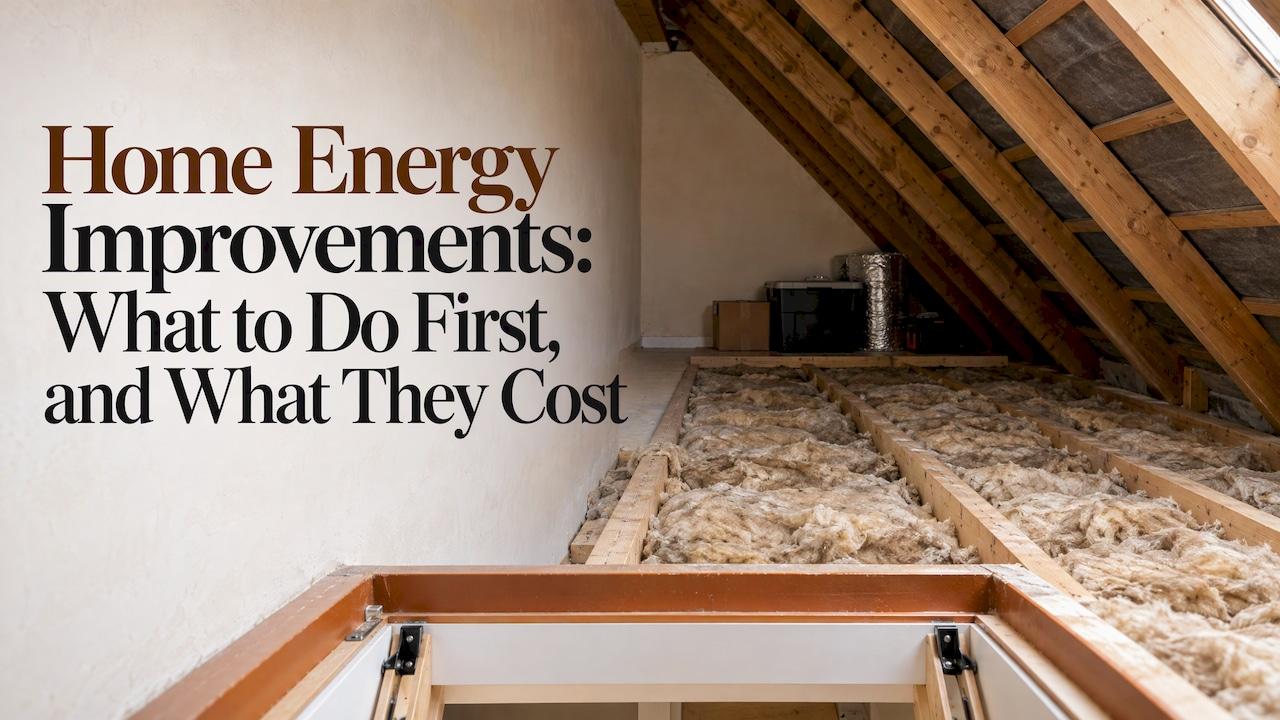
The best home energy improvements are the ones that stop heat escaping: loft insulation, draught-proofing, cavity wall insulation, and then controls such as a smart thermostat. Start with the cheapest measures that fit your house, check what grants you qualify for, and keep ventilation in mind as you seal things up. Below you will find typical UK costs, savings, payback times, what you can safely do yourself and when to call an installer.
TL;DR
- Insulation and draught-proofing usually come first. A smart thermostat and double glazing follow, depending on what your home already has.
- Loft insulation to 270mm costs roughly £500 to £800 for a typical home, according to the Centre for Sustainable Energy, and the saving depends heavily on how much insulation you start with.
- Laying standard loft insulation is usually a sensible DIY job. Blown-in insulation or awkward loft access is one for a professional.
- Check grant schemes before you pay for anything. Some are closing or have already closed.
- Fix damp and leaks first, and never block ventilation when you insulate.
Table of Contents
- Where to start: find out what your home actually needs
- Home energy improvements compared: cost, saving and payback
- Loft insulation: costs, savings and what changes the price
- Walls, floors and windows
- Heating controls and low-carbon heating
- Grants and financial support in the UK
- What you can DIY and when to call a professional
- Safety, ventilation and damp
- How to plan a project so the costs hold
- Perspective
- Plan the jobs around your energy work
- FAQ
- Sources
Where to start: find out what your home actually needs
Before you price anything, work out where your house loses heat. GOV.UK has a free tool, Find ways to save energy in your home, for property owners in England or Wales. It gives recommendations for your address, with an estimated cost, how much you could save on bills and the next steps for each one. Your latest EPC covers similar ground, and it is also what many grant schemes ask for.
The benefits go beyond the bill. Hammersmith & Fulham Council's healthy homes guidance lists lower bills, a home that is warmer in winter and cooler in summer, less damp and mould, lower carbon emissions, a higher property value and access to grants and support.
A sensible order for most homes:
- Draught-proofing and loft insulation (cheap, quick, often DIY).
- Wall insulation, where your walls allow it (usually installer work).
- Heating controls, such as a smart thermostat.
- Windows and glazing.
- Low-carbon heating, such as a heat pump, once the building keeps heat well.
The order matters because a well-insulated home needs a smaller heating system, and a smaller system costs less to buy and run.
Home energy improvements compared: cost, saving and payback
Figures vary with house type, fuel prices and what you start with, so treat any table as a guide. The Property Daily, reporting Energy Saving Trust figures in January 2026, gives these averages:
| Improvement | Typical cost | Typical annual saving | Payback |
|---|---|---|---|
| Smart thermostat | £225 | £175 | 1.3 years |
| Loft insulation | £944 | £260 | 3.6 years |
| Cavity wall insulation | £2,195 | £470 | 4.7 years |
The same report puts double glazing at around £140 a year in savings, and says combining improvements could save the average household an estimated £1,675 a year. Double glazing has a much longer payback, so it often makes sense when windows need replacing anyway, for comfort and noise as well as bills.
Official figures use a different house and different assumptions, so they will not match exactly. The Clean Energy campaign page, based on a gas-heated semi-detached house in EPC band D, says cavity wall insulation can save around £140 a year and costs around £1,000 to £3,000 installed. Both sets of numbers show the same pattern: insulation is among the best-value things you can do, but your own saving depends on your starting point.
Cheap wins that add up
The Property Daily also notes that the Energy Saving Trust sees simple, low-cost changes saving households a further £350 a year. These include draught-proofing doors and windows, using the tumble dryer less, switching appliances off standby and taking shorter showers. None needs a tradesperson.
Loft insulation: costs, savings and what changes the price
Loft insulation is the classic first job, and it is the one most readers ask about. The recommended depth is 270mm. The Centre for Sustainable Energy gives typical costs to top up from 120mm to 270mm:
| Home type | Typical cost | Annual saving (top-up from 120mm) |
|---|---|---|
| Detached house | £800 | £35 |
| Semi-detached | £600 | £17 |
| Mid-terrace | £500 | £13 |
| Detached bungalow | £800 | £35 |
Those top-up savings look modest because you already have some insulation. If your loft is completely bare, the picture changes. The same organisation says loft insulation lasts at least 40 years and can save between £210 and £390 a year from an uninsulated start. Which? reports, using July 2026 fuel prices and Energy Saving Trust data, that insulating a totally uninsulated loft to 270mm saves £360 a year in a detached house, £190 in a semi-detached, £140 in a mid-terrace and £350 in a detached bungalow.
For a wider range, the Clean Energy campaign page puts installation at around £400 to £1,200 for 270 to 300mm, with a saving of around £40 a year for a semi-detached home that already has some insulation.
What moves your price:
- Roof size and house type. More area means more material and more labour.
- Starting depth. A bare loft costs more to fill but saves far more.
- Access. A small hatch or awkward space adds time, and sometimes means a different method.
- Material. Mineral wool rolls, boards for storage areas and blown fibre all price differently.
- Extras. Clearing the loft, raising a boarded floor, or fixing a leaking roof first.
Walls, floors and windows
Wall insulation
Cavity wall insulation gives the largest single saving in the Property Daily figures, an average £470 a year. Whether your home can have it depends on how it was built, and it is injected by a qualified installer. Solid walls need internal or external insulation, which costs more and is a bigger project. Plan these jobs with a surveyor or an installer who is registered with a recognised scheme, and ask for the guarantee in writing.

Floors and draughts
Gaps between floorboards and skirting boards let in cold air, and sealing them is cheap. If you lift boards to run insulation underneath, take care around pipes and wiring. If you are replacing a floor covering anyway, that is a good moment to deal with draughts underneath it.
Windows and doors
Draught-proof strips on existing windows and doors are one of the cheapest upgrades there is. Full double glazing is a larger spend with a longer payback, so treat it as a comfort and maintenance decision as much as a financial one.
Heating controls and low-carbon heating
A smart thermostat has the shortest payback in the figures above, partly because the outlay is small. It lets you schedule heating and adjust it from your phone. Pair it with radiator thermostatic valves, and you can heat the rooms you use.
A heat pump is a bigger step. It tends to work best in a well-insulated home, which is another reason to do insulation first. Grants may help with the cost, covered next.
Grants and financial support in the UK
Support changes often, so confirm everything on the official page before you commit. At the time of writing, here is the picture for England.
Citizens Advice says people in England might apply for the Warm Homes: Local Grant, ECO or the Boiler Upgrade Scheme. Warm Homes applicants usually need a qualifying postcode, means-tested benefits or a household income under £36,000, and an EPC rating of D to G.
The Boiler Upgrade Scheme offers up to £7,500 for an air-to-water heat pump, or £9,000 for off-grid homes using oil or LPG. It also offers £2,500 for air-to-air and £5,000 for a biomass boiler, and you must own the property. ECO is set to close on 31 December 2026, per the same page.

The Great British Insulation Scheme has ended. The Clean Energy campaign page says the GOV.UK referral service has closed and the scheme officially finished on 31 March 2026, while ECO4 remains open. Scotland, Wales and Northern Ireland run their own schemes, so check the government pages for your nation.
If you do not qualify, the saving on your bills still pays for much of the work over time, especially for loft and wall insulation.
What you can DIY and when to call a professional
The Centre for Sustainable Energy says laying standard loft insulation is usually straightforward for a competent DIYer. Blown-in insulation, or a loft with difficult access, is a job for a professional installer.
Good DIY candidates:
- Laying mineral wool rolls between and over joists.
- Draught-proofing doors, windows, letterboxes and keyholes.
- Fitting radiator reflector panels and thermostatic valves.
- Sealing gaps around skirting boards and pipework.
Call a professional for:
- Cavity wall insulation and solid wall insulation.
- Blown-in loft insulation or lofts with poor access.
- Heat pumps and any gas, electrical or structural work.
- Anything where you suspect damp, damaged roofing or asbestos.
Safety, ventilation and damp
Energy work can cause problems if rushed. Four checks cover most of them.
Fix damp first. The Centre for Sustainable Energy advises that your loft needs to be in good condition and dry before you insulate it. Otherwise the insulation will not work properly and you could trap dampness and mould. Gaps in tiles and leaking pipes need fixing first.
Keep the gaps. Wickes' loft guide says to keep a 25mm gap at the eaves for ventilation and leave a 75mm gap around hot chimneys, flues and recessed lights. It also says not to lay insulation over electric cables.
Protect yourself. The same guide advises turning off the power at the consumer unit before touching cables, working from crawling boards and never standing between joists. Wear goggles, a suitable face mask and gloves.
Do not choke the house. As you make a home more airtight, ventilation matters more. Welsh Government guidance in the 2026 edition of Approved Document F, which takes effect on 4 March 2027, says that when you carry out energy efficiency work on an existing home, an assessment should decide what extra ventilation is needed. It also says building work should not reduce existing ventilation. That is Welsh guidance, but the principle is sound anywhere. Check the rules for your nation with your local building control team before structural work.
How to plan a project so the costs hold
Most overspends come from not knowing the full job. A short plan avoids them:
- List the measures in the order above and note which are DIY.
- Measure the area. Loft floor area, wall length, window count.
- Write the materials list with quantities and a waste allowance.
- Price it in three tiers: budget, mid-range and premium.
- Add tools and safety gear such as boards, goggles, masks and gloves.
- Set a timeframe, including time to fix anything the work uncovers.
- Check grants before buying anything you might have been able to claim.
Perspective
Energy improvements often stall for the same reason as other home projects: people do not know what to buy, how much it will cost or where to begin. A loft job that looks like a one-line task turns into a list of rolls, boards, tools, protective kit and a weekend.
That is why we built Scopebase around plain English. Describe the job, and we give you a materials list, cost estimates across budget ranges, a timeframe, step-by-step instructions and safety advice, with the shopping list grouped by store. Our prices are indicative, so you can see roughly what you are getting into before you commit.
We have detailed planners for painting, flooring, tiling, partition walls, decking, fencing and shelving, and rough guides for other jobs. You do not need an account to try it. Our view is simple: people who plan before they buy feel more confident, waste less and finish more of what they start.
Scoped
Plan the jobs around your energy work
Most energy upgrades come with finishing work: redecorating after draught-proofing, replacing a floor after dealing with gaps underneath, or building shelving in a newly usable loft. Scopebase helps you plan those jobs. Our painting and decorating planner turns a plain-English description into a materials list, costs, timings and steps.

If you are replacing flooring while the boards are up, try the laminate and click-vinyl flooring planner. For anything else, start at Scopebase and describe the job in your own words. It is free to use.
FAQ
What is the cheapest home energy improvement?
Draught-proofing is one of the cheapest. The Energy Saving Trust, as reported by The Property Daily, says simple low-cost changes such as draught-proofing, less tumble dryer use and shorter showers can save a household a further £350 a year. You can do all of them yourself.
How much does loft insulation cost?
The Centre for Sustainable Energy gives typical costs of £500 for a mid-terrace, £600 for a semi-detached and £800 for a detached house or bungalow, to top up from 120mm to 270mm. The Clean Energy campaign page gives a wider range of around £400 to £1,200. Your price depends on roof size, access and the material you choose.
Can I insulate my loft myself?
Usually, yes, if you are competent at DIY and the loft is easy to reach. Standard roll insulation is straightforward. Blown-in insulation or awkward access is a job for a professional installer. Whichever route you take, keep the eaves gap clear and keep insulation off electric cables.
Are there grants for home energy improvements?
In England, options include the Warm Homes: Local Grant, ECO and the Boiler Upgrade Scheme, each with its own eligibility rules. The Great British Insulation Scheme ended on 31 March 2026. Check GOV.UK for the current position and for schemes in Scotland, Wales and Northern Ireland.
Which improvement saves the most money?
In the Property Daily's average figures, cavity wall insulation saves the most at £470 a year, followed by loft insulation at around £260 and a smart thermostat at around £175. Your own best saving depends on what your home already has, so start with your EPC recommendations.
Sources
- Find ways to save energy in your home, GOV.UK
- Going green: How homeowners could save thousands, The Property Daily
- Insulate your home, Clean Energy campaign
- Loft insulation, Centre for Sustainable Energy
- Loft insulation costs and savings, Which?
- Get help paying for energy efficiency home improvements, Citizens Advice
- How to insulate a loft, Wickes
- Approved Document F Volume 1, Welsh Government